
P — Present Position
Map one workflow as it works today. Who does it? How long does it take? Where do errors, rework and hesitation appear?
Ask: Are people skeptical, interested but time-poor, or already using AI without enough review?
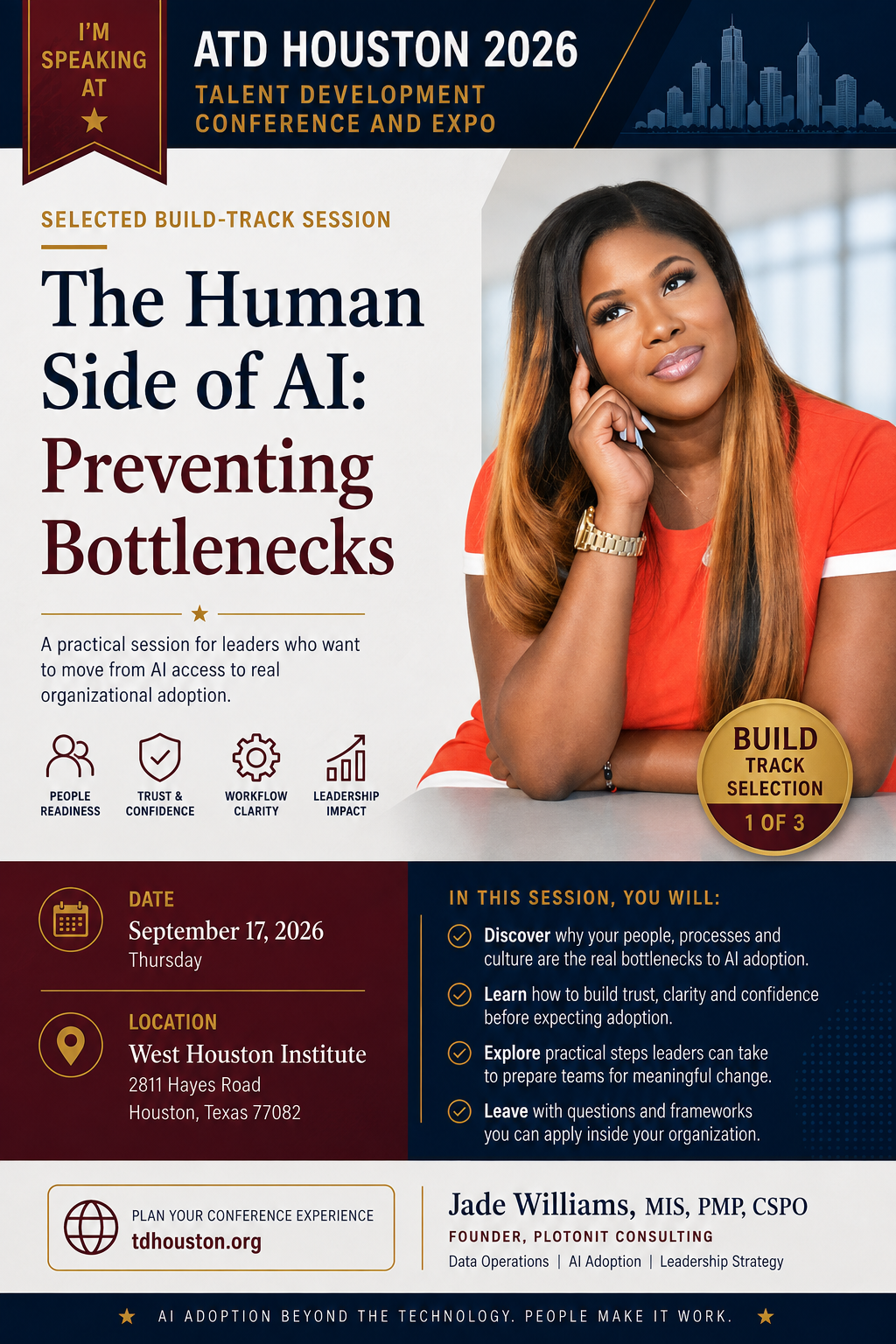
Join Jade Williams for a practical, people-first conversation about what happens after an organization buys the AI tool — and why adoption, trust, workflow clarity and leadership behavior determine whether the investment actually works.
A practical session for leaders who want to move from AI access to real organizational adoption.
Watch live, follow the deck, answer live polls, capture notes and access session resources from one place.
Conference materials may be available elsewhere on this page after the event.
Enter one word or one short phrase. Responses are anonymous and may appear on the presentation screen.
The Human Side of AI: Preventing Bottlenecks · ATD Houston 2026
Open the broadcast on Facebook. Keep this conference page open for slides, live polls, notes and resources.
Opens in a new tab. Facebook may ask you to sign in. Replay availability depends on the broadcast’s settings.
Choose one answer per poll. Your first saved answer stays recorded when you change tabs or refresh. Percentages include everyone who answered that question, including earlier and later votes. Names are not displayed.
Notes stay in this browser unless you copy or download them. Plot On It does not receive them.
Submit a question anonymously for the live discussion. Your name and email are not requested.
Take the conversation back to your team: understand the bottleneck, protect time to learn, and test one useful workflow. These resources follow Jade’s 23-slide presentation.
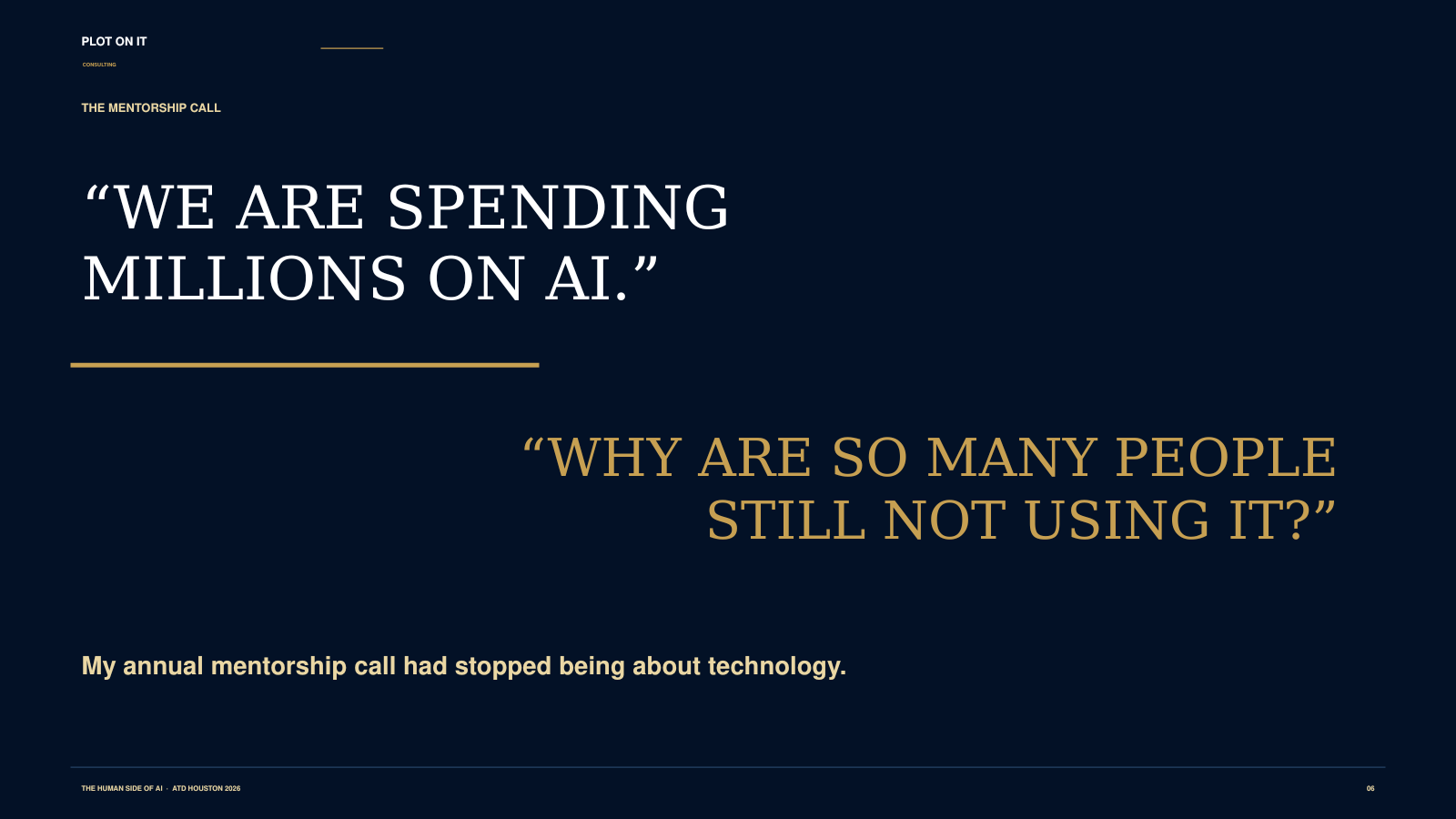
Buying a tool does not create adoption. Jade’s conversation begins with a leadership question: why are capable people not using the AI already available to them? The answer may be fear, lack of practice time, unclear rules or confidence without enough judgment.
The PLOT framework helps you diagnose and plan. The speech’s four readiness conditions—purpose, trust, capability and leadership—help you put that plan into practice.
Map one workflow as it works today. Who does it? How long does it take? Where do errors, rework and hesitation appear?
Ask: Are people skeptical, interested but time-poor, or already using AI without enough review?
Start with approved tools, team expertise, existing data and learning resources you already have. Choose a useful task before adding another subscription.
Ask: What can we safely improve using the people and systems already available?
Name the barrier: job fears, no protected learning time, unclear data rules, poor workflow fit or missing manager support.
Act: Assign an owner to remove that barrier. Provide role-relevant training during work and define human review.
Define one measurable 30-day result. Record the starting point, an accountable owner and a review date.
Measure: Time, quality, exceptions and confidence—not just logins. Scale only when the workflow meets your agreed checks.
Purpose: a useful task and clear outcome. Trust: approved data, boundaries and human review. Capability: required, role-relevant learning with protected practice. Leadership: managers model use, remove unnecessary steps and review results.
Your commitment: What is one condition you will create in the next 30 days? Write it in My Notes, then copy or download your notes to keep them.
Want help applying this to your team? Bring your completed PLOT worksheet to a conversation with Jade about your workflow, adoption blockers and next implementation step.
The session is built to help leaders diagnose where adoption is actually getting stuck—and what to change before blaming the technology.
Separate technology problems from unclear workflows, weak ownership, inconsistent communication and low employee confidence.
Use practical questions to assess leadership alignment, process clarity, training needs, governance and psychological safety.
Connect AI use to real responsibilities, manager coaching, experimentation and measurable business outcomes.
Access does not equal adoption. Employees still have to understand where AI belongs in the work, what responsible use looks like, what changes in their role and how they will be supported while learning.
When those questions are unanswered, organizations often label the result as “resistance.” But what looks like resistance can be a rational response to unclear ownership, inconsistent training, poorly documented processes or fear about how work will change.
The Human Side of AI: Preventing Bottlenecks reframes AI adoption as an operating and change-management challenge—not a software-installation event.
Define the business problem and current process before deciding where AI belongs. A new tool cannot repair a process the organization does not understand.
Trust grows when leaders acknowledge limitations, explain safeguards and create space for employees to test and learn without being punished for uncertainty.
General demonstrations create awareness. Adoption grows when employees practice AI within the responsibilities, decisions and outcomes they already own.
Employees notice what leaders use, reward, question and protect. Visible leadership participation makes AI adoption an operational priority instead of another announcement.
Are employees resisting AI—or responding logically to an unclear implementation?
Can your team explain the business problem AI is supposed to solve?
Are managers prepared to coach experimentation, mistakes and changing expectations?
Do your processes, ownership, data and governance support responsible use?
How will you distinguish real adoption from simply giving people access?
These independent resources expand on AI readiness, workforce learning, organizational change and human-AI interaction.
Research on employee agency, management behavior and the conditions that influence AI readiness and trust.
Read the research →Why putting AI in employees' hands is not enough—and why people need to participate in redesigning the work.
Read the article →Research on the gap between employee experimentation and formal organizational adoption.
Read the article →Guidance on human roles, responsibilities and limitations when people interact with AI systems.
Explore the guidance →
Jade Williams is the founder of Plot On It Consulting and a data operations leader whose work connects people, process, project execution and responsible technology adoption.
Her approach to AI begins with a practical question: Is the organization prepared to change the way work is performed? She helps leaders look beyond the tool and examine the workflows, communication, training, ownership and employee experience that determine whether transformation succeeds.
Join the BUILD-track conversation at ATD Houston 2026 and leave with practical questions you can take back to your own team.