
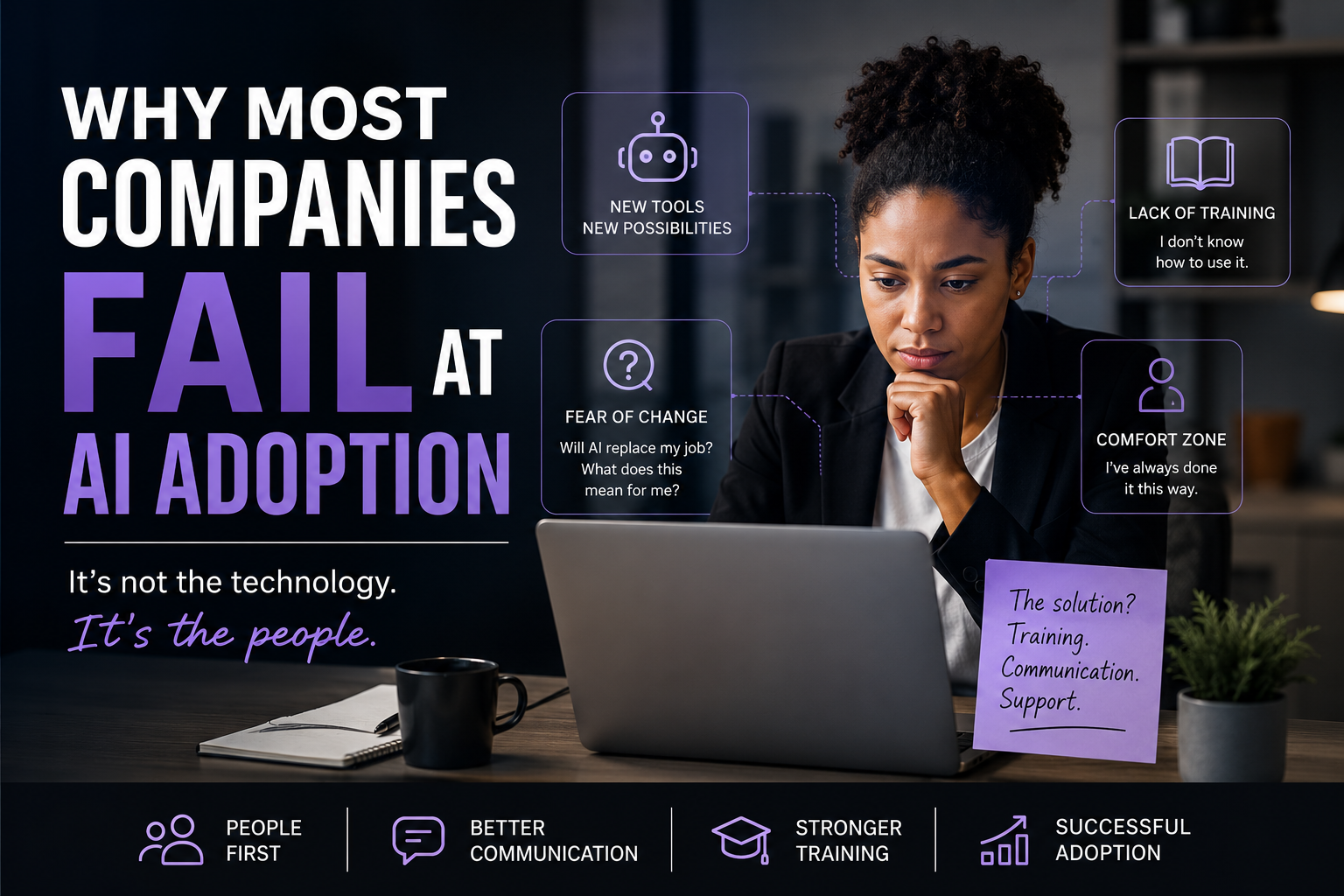
Why Most Companies Fail at AI Adoption
By Jade Williams • Founder, The Confidence Project™
Why are companies spending millions on AI tools that employees barely use?
That’s a real question I’ve been thinking about lately after having a conversation with the Global Chief Information Officer at my company about AI adoption in the workplace. I meet with him at least once a year to discuss different operational challenges, technology conversations, and ideas around transformation. During one of those discussions, we started talking about AI and why adoption still seems low in a lot of workplaces despite how heavily organizations are investing into it.
We talked about how much organizations are putting into AI, Copilot, automation tools, and digital transformation overall, but when you actually look around inside most companies, a lot of employees still are not fully using these tools the way leadership expected them to.
The Real Barrier Isn't Technology—It's Fear
And honestly, I don’t think the problem is the technology. I think people are scared of it.
Some people are afraid AI is going to replace their jobs. Some people genuinely do not know how to use it. And others have spent years becoming the “go-to” person for certain knowledge, processes, reports, or systems, so naturally there’s fear around losing that value or relevance.
That fear doesn’t always show up out loud either. Sometimes it looks like:
- Avoiding the tool
- Refusing to learn it
- Saying it’s “too complicated”
- Or simply continuing to do things the old way because that feels safer
A Shift in Leadership Approach
What really made me think deeper about this was realizing how often this comes up even on my own team. A lot of times when someone runs into a barrier, gets stuck on a process, or is trying to figure something out, one of the first things I ask is: “Did you try using Copilot?”
And honestly, the answer is usually no. Not because they are incapable. Not because they do not want to do their jobs well. But because many employees still have not built the habit of naturally using AI as part of their workflow yet.
As a manager, that also forced me to think differently about leadership. It’s easy to tell employees to “use AI,” but how do we actually encourage adoption in a way that feels practical and not forced? How do we create an environment where people feel comfortable experimenting with it without feeling judged, overwhelmed, or threatened by it?
During the conversation, I mentioned that I thought organizations may want to focus more on training and visibility instead of assuming employees would automatically adopt AI just because access was available. A few days later, I started noticing a much bigger push internally around AI learning and communication. I began seeing more visible discussions around Copilot, AI Teams integrations, workplace AI chats, and practical ways employees could actually use these tools in their daily work.
Some of those resources may have already existed before, but if employees do not clearly see them, understand them, or feel encouraged to use them, then adoption is still going to be low.
It's a People Problem
That’s something I think a lot of organizations are missing right now. AI adoption is not just a technology problem. It’s a people problem.
You cannot expect transformation without helping people understand how the transformation benefits them personally. Most employees are not asking: “Can AI make the company more efficient?” They are asking: “What does this mean for me?”
And until leadership answers that question clearly, resistance will continue no matter how advanced the technology becomes. The organizations that will truly succeed with AI are not just the ones investing in tools. They are the ones investing in:
- Communication
- Training
- Operational integration
- Helping employees feel like they are part of the future instead of being replaced by it
Because at the end of the day, technology does not transform businesses by itself. People do.
So now I’m curious: For those of you working in corporate environments, are employees at your company truly using AI tools consistently, or are most people still hesitant to fully adopt them?